USDA Hardiness Zones: What They Mean for Perennials
A perennial can look healthy at the nursery and still struggle after its first New Jersey winter. A USDA hardiness zone helps you judge whether a plant is likely to withstand local winter cold, but it cannot predict every yard’s conditions or guarantee success. Here’s how to use the map as a starting point, then factor in exposure, soil, drainage, and the plant’s needs.
What a USDA hardiness zone tells you
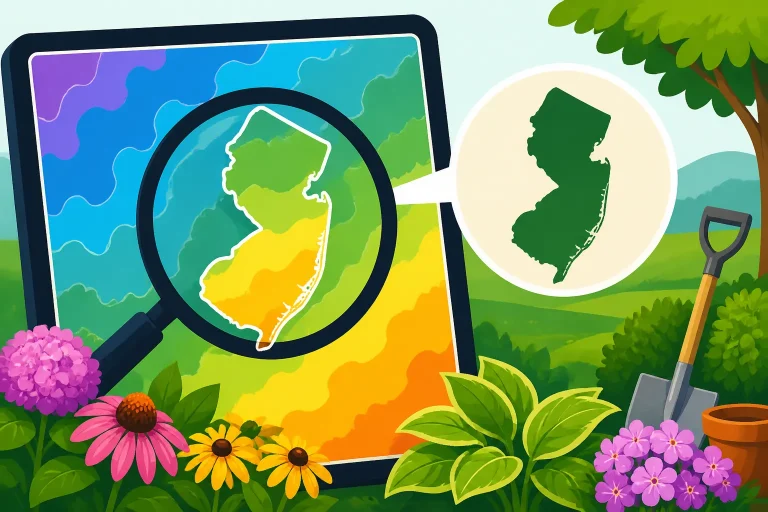
A USDA hardiness zone is a guide to the winter cold a plant may be able to withstand. The USDA Agricultural Research Service says the map is based on average annual extreme minimum winter temperature. In practical terms, it helps you compare a perennial’s cold tolerance with the conditions indicated for your area.
That makes the map useful when you’re choosing a plant expected to return after winter. If the perennial’s hardiness range is compatible with the zone where your garden falls, it may be a reasonable candidate. If the listed range does not include your area, the plant may be more vulnerable to winter injury or loss.
The map is a screening tool, not a promise. A matching zone cannot tell you whether a plant will get enough sun, whether its roots will sit in wet soil, or whether a sheltered spot will stay warmer than an exposed one. It also cannot predict the exact conditions in your garden over the coming winter.
A zone can help answer a narrow question: “Is this perennial considered hardy enough for the average winter cold in my area?” It does not answer broader questions such as:
- Will this plant thrive in my soil?
- Is my garden sunny or shady enough for it?
- Will a low, damp planting bed suit its roots?
- Is the spot exposed to winter wind?
- Will the plant flower well through the growing season?
Those questions matter because perennial success depends on more than winter survival. A plant may live through cold weather but grow weakly, flower sparsely, or decline over time because its light, moisture, or soil needs are not met.
When reading a plant label, look for the stated hardiness information and treat it as one part of the decision. Labels and catalog descriptions may present ranges in different ways, so compare the plant’s stated tolerance with the zone shown for your location rather than relying on a familiar-sounding name or a broad regional description.
For a useful overview of what the map can and cannot tell you, see Using the USDA Plant Hardiness Zone Map for Garden Plants. If you need to locate your area on the digital map, How to Find Your Exact USDA Zone on the Digital Map can help you take that step.
How to use the map when choosing perennials
The most useful way to use a hardiness zone is as an early filter. It helps you narrow a long list of possible plants before spending time comparing their other needs. It should not be the final word on whether a perennial belongs in a particular bed.
Start with the garden location
Begin by identifying the area where you intend to plant. A ZIP code lookup or map view can point you toward the zone associated with a broad location, but it cannot describe every corner of a property. The open side of a yard, a sheltered foundation bed, and a low area that collects cold air may not behave alike.
Use a map result to orient your decision, not to assign a guarantee to an individual garden bed. If a plant is close to the edge of its stated tolerance, the exact location within the yard becomes more important. A protected site may offer better odds than a windy, exposed one, though shelter does not erase the plant’s basic needs.
You can compare the map result with the perennial’s label, then consider whether your site is likely to be more exposed or more sheltered than the surrounding area. For instructions on checking an area by ZIP code, see How to Check Your New Jersey Hardiness Zone by ZIP Code.
Read the plant’s hardiness information carefully
A perennial’s hardiness information indicates the winter conditions it is expected to tolerate. Check the full range or description rather than focusing only on a single part of a label. The key question is whether your garden area falls within the plant’s stated tolerance.
If it does, that makes the plant a candidate, not a sure thing. If it does not, consider how important reliability is for that bed. A plant with a marginal fit might be worth trying in a protected spot if you are comfortable with some risk, but it may be a poor choice for a prominent planting where dependable return matters.
Hardiness labels are most useful when compared alongside the plant’s other requirements. A perennial that can tolerate winter cold may still be a bad fit for heavy shade, dry sandy soil, or a consistently wet bed. The label tells you something important, but not everything you need to know.
Compare the map with the site
Before choosing a plant, look at the bed itself. Note whether it faces an open or sheltered direction, whether structures block wind, how quickly water drains, and how much direct light reaches the area. These details help you decide whether the spot is likely to support the plant beyond winter.
A basic selection process can look like this:
- Find the zone shown for your general location.
- Check the perennial’s hardiness information.
- Decide whether the plant’s winter tolerance is a comfortable fit or a borderline one.
- Compare the plant’s light and soil preferences with the actual bed.
- Consider local exposure, drainage, and nearby heat-retaining surfaces.
- Choose the plant only if the whole site appears suitable.
This approach avoids a common mistake: treating the map as if it were a complete planting recommendation. The map helps screen for cold tolerance; your garden conditions determine whether the plant is likely to grow well there.
Why a New Jersey yard may differ from the map
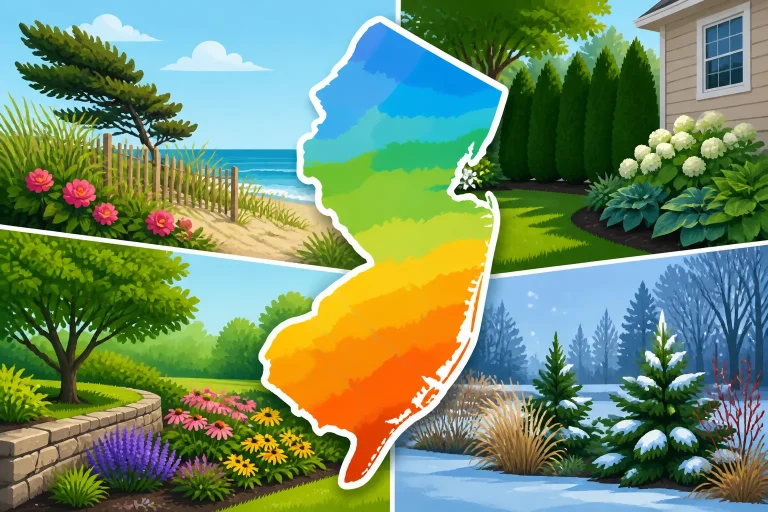
A map simplifies a complicated landscape. In New Jersey, a broad regional reading can be a starting point, but conditions may vary within a town, neighborhood, or even a single property. A plant’s real experience depends on the site where its roots and crown are growing.
Exposure and shelter
Wind can make an exposed bed a harsher place for a perennial than a sheltered one. A fence, hedge, or building may reduce exposure, while an open area may receive more wind. The effect depends on the layout and the plant’s position, so don’t assume that every bed close to a structure is protected.
Shelter also has trade-offs. A spot near a building may receive less wind, but it could have dry soil under an overhang, reflected heat, or limited room for roots. The best location is not automatically the warmest or most sheltered one; it is the location that fits the plant’s overall needs.
Low areas and cold-air movement
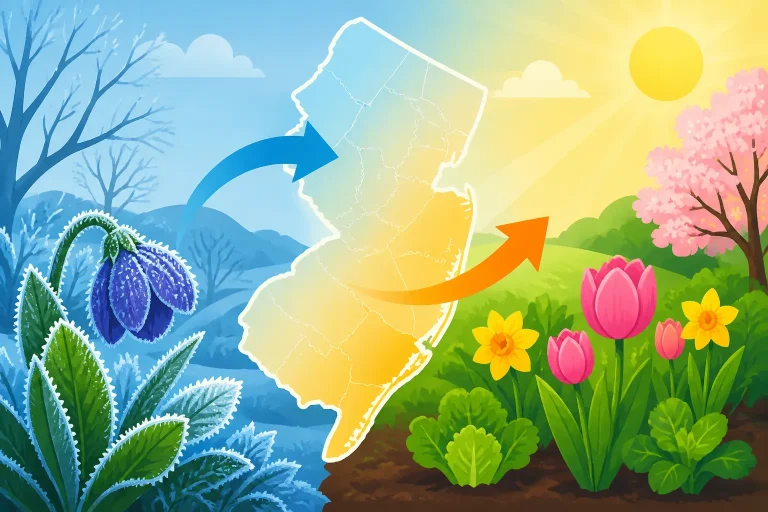
Cold air can settle in low spots, creating a different winter or spring environment from a nearby slope. A small dip in the yard may therefore behave differently from higher ground. Pay attention to where frost tends to linger, where water collects, and which areas feel exposed.
That does not mean every low bed will fail with perennials. It means the location deserves attention, particularly for plants that are already near the edge of their cold tolerance or sensitive to wet conditions. If the bed stays soggy, poor drainage may be as important as winter cold.
For a closer look at how yard conditions can create zone differences, read Microclimates and Zone Discrepancies Across New Jersey Yards. The related Why Low Spots in a New Jersey Yard Frost First also explains why the lowest part of a property may not behave like the rest.
Sun, reflected heat, and hard surfaces
Walls, paving, and other hard surfaces can change the conditions around a planting bed. Depending on the site, these surfaces may reflect heat or help a nearby area retain warmth. They can also make a bed hotter or drier during the growing season.
That may benefit some plants while creating stress for others. A perennial that prefers cooler, more evenly moist conditions may not appreciate a hot strip beside paving. A sun-loving plant could be better suited there, provided the soil and moisture are appropriate.
Use the zone map to consider cold tolerance, then look for other conditions that may affect the plant in that exact bed. The map does not measure reflected heat, shade, moisture, or wind exposure.
Regional differences are not a substitute for a site check
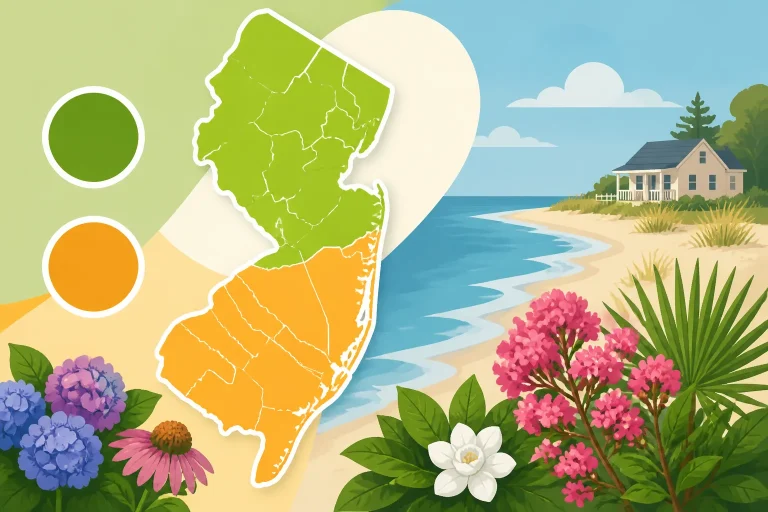
New Jersey includes varied landscapes and local conditions, so a regional description should not be treated as a substitute for checking the map and the garden. A label that says a plant suits a broad part of the state may not account for a particular exposed slope, sheltered courtyard, or damp hollow.
If you are comparing locations, use the map consistently and then assess each site separately. Two beds at the same property can call for different perennial choices. A sunny, well-drained bed may suit plants that would struggle in a shaded, moist corner, even if both beds fall in the same map zone.
Hardiness is not the same as overall suitability
The most important limitation of a hardiness zone is that it describes only one aspect of a plant’s environment. A plant may survive winter cold and still perform poorly if the growing conditions are wrong. For perennials, a good match means fitting the site across the full growing cycle, not merely making it through winter.
Winter survival versus strong growth
A perennial that returns after winter may still be stressed. It might produce fewer flowers, grow slowly, or be less resilient to other challenges. Survival is a basic threshold, not a guarantee of healthy growth or a long-lasting display.
For that reason, compare more than hardiness. Check the plant’s preferences for light, soil moisture, drainage, and soil type. Consider mature size and how much space it needs. If the plant spreads or forms a large clump, make sure the bed can accommodate it without crowding neighboring plants.
Soil and drainage
Soil conditions can make a suitable-looking plant struggle. Some perennials cope with dry, free-draining ground; others need steady moisture. A plant that dislikes wet roots may decline in a bed where water sits after rain, even if the winter cold is within its tolerance.
Observe the site after rainfall and through dry periods. Does water drain away, or does the soil stay saturated? Does the bed dry out quickly? Is the soil compacted or easy to work? These observations can help you avoid choosing a plant whose moisture needs are at odds with the bed.
If you are still building a planting plan, Matching Native New Jersey Plants to Your Soil and Light offers a useful way to think about conditions beyond hardiness. Designing Resilient Flower Beds for New Jersey Landscapes can help when you are combining plants with different needs.
Light and seasonal conditions
A perennial can be cold-hardy but poorly suited to the amount of light at its planting site. A sun-loving plant in a shaded bed may become weak or flower less well. A plant adapted to shade may struggle in a hot, bright location.
Assess the bed through the growing season rather than relying on a quick glance. Trees leaf out, shadows shift, and nearby structures affect light at different times. The description on a plant label may use terms such as full sun or partial shade; compare those terms with the conditions the bed actually receives.
Plant health and maintenance
Good site matching can reduce stress, but it does not remove the need for basic care. Newly planted perennials need suitable watering while roots establish. Plants may need division when they become crowded, and damaged or declining growth may need investigation. A hardiness zone does not tell you how to water, prune, divide, or diagnose a plant.
Plan for the plant’s mature form and maintenance needs before planting. A perennial that suits the zone but grows too large for a narrow bed can create a different kind of problem. If a plant is crowded, it may compete for light, water, and space. For an established clump that has outgrown its place, see Dividing Overcrowded Perennials in Autumn Garden Beds.
Choosing perennials when winter tolerance is marginal
A borderline plant is not automatically impossible to grow, but it involves more uncertainty. The decision comes down to how much risk you are willing to accept, how important the plant is to the design, and whether the site offers favorable conditions.
Decide how much reliability matters
For a foundation planting, a public-facing bed, or a garden where you want dependable year-to-year structure, favor plants whose hardiness information is a comfortable fit. This reduces the chance that a difficult winter will leave a conspicuous gap.
In a smaller experimental bed, you may be more willing to try a plant near the edge of its listed tolerance. If it does not return, the loss may be manageable. This can be a reasonable way to test a plant without depending on it as the backbone of the whole design.
Think about the role of the perennial, not only its appearance. Is it a central feature, a filler, or a plant you are curious to try? The more important it is to the bed’s structure, the more cautious the choice should be.
Choose the site with care
If you do try a marginal plant, give it a location that matches its other requirements and avoids unnecessary stress. A sheltered position may be preferable to an exposed one, but only if the plant also receives suitable light and soil moisture. The warmest spot is not automatically the right spot.
Avoid planting based on a presumed microclimate without checking how the bed behaves. Observe the area through weather changes, and note whether it is windy, waterlogged, shaded, or unusually dry. A favorable site can improve the odds, but it cannot change the perennial’s basic winter tolerance.
Keep the planting flexible
A garden design can account for uncertainty. Use reliable perennials for the main structure, then reserve a smaller space for plants that are less certain. If a marginal plant does not persist, you can replace it without having to rebuild the entire bed.
It also helps to avoid relying on a single plant for a major seasonal effect. If a plant is important for a particular color, height, or flowering period, include other plants that can provide some of that function. This makes the bed less dependent on one plant surviving in a borderline location.
Pay attention after planting
Watch how the perennial responds during its first growing seasons. Healthy new growth, appropriate flowering, and steady establishment suggest that the site is reasonably suitable, though they do not guarantee future winter performance. If the plant struggles, check the full set of conditions rather than blaming the zone alone.
Look for patterns: does the bed remain wet, dry quickly, receive less sun than expected, or experience strong wind? Correcting a site mismatch may help more than adding protection to a plant that is in the wrong place. If the plant continues to decline, choosing a better-matched perennial may be the practical solution.
A practical checklist for reading plant labels
When you compare nursery labels, catalogs, or online descriptions, use a consistent checklist. It can keep you from focusing on a single attractive feature while overlooking an important limitation.
| What to check | What it helps you decide |
|---|---|
| Hardiness information | Whether the plant is a reasonable candidate for the winter cold in your area |
| Light preference | Whether the bed receives suitable sun or shade |
| Soil moisture preference | Whether the plant can cope with the bed’s usual moisture |
| Drainage needs | Whether the soil is likely to stay too wet or dry too quickly |
| Mature size | Whether the plant will fit without crowding neighbors |
| Exposure | Whether the site is sheltered or subject to wind and cold-air settling |
| Maintenance needs | Whether the plant’s care fits your time and gardening approach |
Use the table as a way to organize questions, not as a scoring system. A plant that matches most categories but has a serious mismatch in drainage or light may still be a poor choice.
Questions to ask before buying
Before bringing a perennial home, ask whether the label gives a hardiness range or general description, and whether your mapped area falls within the stated tolerance. Then consider what you know about the planting site. If the site is a low, damp corner and the plant requires dry, well-drained soil, the soil mismatch deserves more attention than a broadly compatible zone.
Ask whether the plant will have room at maturity and whether neighboring plants will shade it. Think about the bed in both summer and winter. A location that looks sunny before nearby trees leaf out may become more shaded later. A bed beside a wall may be sheltered but also dry or hot.
If the information is incomplete, avoid treating missing details as evidence that the plant will suit your garden. Look for a fuller description or choose a perennial with clearly stated needs that match the site. A little comparison before planting can save the effort of replacing a poorly matched plant later.
Keep a simple garden record
A basic record can make future decisions easier. Note the plant’s label information, where you planted it, and how the location behaves. Record whether it is windy, shaded, dry, or slow to drain. If the plant performs well or poorly, those observations can help you distinguish a winter issue from a site mismatch.
You do not need a formal chart. A note beside a garden sketch or a short description in a planting record is enough. The purpose is to remember what the map alone cannot show: the conditions of that particular bed.
Build a planting plan around the site, not just the zone
The strongest perennial plans combine a hardiness check with close observation of the garden. Start by finding the map result for your general location, then compare it with the plant’s stated winter tolerance. After that, evaluate the bed for light, soil, drainage, exposure, and available space.
For a bed you want to rely on, choose plants whose hardiness is a comfortable match and whose growing needs fit the site. Keep less-certain choices to a smaller part of the garden, especially when they would otherwise be responsible for the bed’s main structure or seasonal display.
It is also sensible to plan for the garden you have, not the garden you wish the site would become. If a spot stays wet, choose plants suited to those conditions or improve the site where appropriate. If shade is persistent, select plants that tolerate it rather than expecting a sun-loving perennial to adapt. If the bed is exposed, prioritize plants that can handle the conditions there.
This does not mean the map is unimportant. It gives you a valuable first check, especially when a perennial is expected to return year after year. The mistake is asking it to do more than it can. The zone cannot tell you whether a plant will get enough light, whether its roots will rot in wet ground, or whether the bed is too exposed.
A useful decision can be summarized this way: use the map to screen for winter cold, use the plant description to understand its needs, and use the garden itself to decide where it belongs. That combination is more reliable than relying on a zone label alone.
If the map and the site appear to disagree, take another look at the location and the plant information before assuming one is wrong. A mapped zone describes a broad area, while a garden bed has its own conditions. You may find that the plant is suited to the broader area but not to that specific bed, or that a sheltered location gives it a better chance than an open one.
For colder parts of the state, Hardy Perennial Choices for Cold Northwestern Winter Exposure can help focus the search on cold-tolerant options. For broader garden planning, Managing Seasonal Freeze Transitions Across New Jersey Yards can help put winter and seasonal temperature changes in context.
The best takeaway is straightforward: a USDA hardiness zone is a useful starting point for choosing perennials, not a guarantee of success. Match the plant’s winter tolerance to the mapped area, then make the final choice based on the actual conditions in your New Jersey garden.
Frequently Asked Questions
Does a matching USDA hardiness zone mean a perennial will thrive?
No. A matching zone suggests that winter cold may be within the plant’s tolerance. The plant still needs appropriate light, soil, drainage, moisture, and space.
Can two gardens in the same area have different growing conditions?
Yes. Exposure, shelter, slope, low spots, shade, and nearby hard surfaces can make beds behave differently. Check the actual planting site rather than assuming that every part of a property has identical conditions.
Should I plant a perennial outside its stated hardiness range?
You can choose to try it, but the outcome is less certain. Consider how important the plant is to the bed and whether the site is sheltered and otherwise well suited to it. For a dependable planting, choose a plant whose stated tolerance includes your area.
Is the hardiness zone the same as a planting calendar?
No. A hardiness zone is a guide to winter cold tolerance. It does not set exact planting dates or describe the best time to plant a particular perennial. Local conditions and the plant’s needs still matter.
Sources
- USDA Agricultural Research Service — 2023 USDA Plant Hardiness Zone Map | USDA Plant Hardiness Zone Map (checked November 15, 2026)
Disclaimer
This article is for general informational purposes only and does not constitute professional advice. Laws, prices and regulations vary by location and change over time. Consult a qualified professional for guidance on your specific situation. New Jersey Gardening Guide is not a government agency and is not affiliated with any university extension, state department of agriculture or other government agency.